Language Degrees Are Dying and That's the Best Thing to Happen to Language Learning
University language programs are collapsing, and that's great news. Here's why the death of the language degree is creating space for better, rebel-driven approaches to fluency.
The Language Degree Is on Life Support
Language degrees are dying, and the people who should be mourning are throwing a party instead. University language departments across the UK and US are shuttering at an alarming rate, with enrollment plummeting and faculty being shown the door. According to a recent investigation by The Tab, the crisis in language degrees has reached a tipping point — and the people running these programs are finally asking the uncomfortable question they should have asked decades ago: did we do this to ourselves?
The answer, if you're willing to hear it, is a resounding yes. And the death of the language degree might be exactly the wake-up call the language learning world needs.
How Universities Ruined Language Learning for an Entire Generation
Here's the dirty secret that every language graduate knows but rarely admits: after three or four years of studying a language at university level, most graduates still can't hold a fluid conversation with a native speaker. They can analyze literature, conjugate irregular verbs in the subjunctive, and write essays about linguistic theory — but ask them to negotiate a phone contract in their target language and they freeze.
This isn't a failure of the students. It's a catastrophic failure of the system.
University language programs have historically prioritized:
- Grammar analysis over communicative competence
- Literary criticism over practical fluency
- Written exams over spoken assessment
- Perfectionism over risk-taking
- Academic prestige over student outcomes
The result? Generations of students who associate language learning with stress, failure, and outdated textbooks. As one language learner put it on Reddit's language learning community: "My university French class made me hate French. It took me five years after graduating to realize I actually loved the language — I just hated how it was taught."
The Numbers Don't Lie (And They're Brutal)
Enrollment in modern language degrees has dropped by over 30% in the last decade at many institutions. Entire departments — French, German, Italian, Japanese — are being merged, downsized, or eliminated entirely. The people who built their careers teaching conjugation tables are genuinely shocked that students stopped showing up.
But here's what the hand-wringing articles about the "language crisis" always miss: interest in learning languages has never been higher. Language learning apps have hundreds of millions of users. Polyglot YouTube channels pull millions of views. Language exchange meetups are packed in every major city. People want to learn languages — they just don't want to do it the way universities have been teaching them.
The demand didn't disappear. It migrated. And it migrated because the traditional model was fundamentally broken.
What the Rebels Got Right That Academia Got Wrong
While universities were busy debating the Oxford comma in intermediate French, a generation of independent language learners figured out what actually works through trial, error, and sharing their results online. The principles they discovered aren't new — linguists like Stephen Krashen have been advocating for them since the 1980s — but they're finally reaching a mainstream audience.
Communication Over Correctness
The rebel approach prioritizes getting your message across over getting your grammar perfect. This isn't about being sloppy — it's about understanding that chasing perfection actively sabotages fluency. You don't learn to swim by studying hydrodynamics. You learn by getting in the water and flailing until it clicks.
Research consistently supports this. A meta-analysis in Applied Psycholinguistics found that communicative language teaching methods produce significantly better outcomes in spoken fluency than grammar-translation methods — the very methods most university programs are still built around.
Input Before Output
The most effective independent learners spend the majority of their time consuming the language — listening to podcasts, watching shows, reading books — rather than drilling grammar rules or memorizing vocabulary lists. This massive comprehensible input approach builds an intuitive feel for the language that no amount of explicit rule-learning can replicate.
This is why apps alone don't make you fluent either. Most apps are just digitized textbooks — same grammar-translation approach, shinier packaging. The rebels figured out that you need real content, created for real native speakers, consumed in real quantities.
Emotion and Identity Over Academic Detachment
Here's something universities completely missed: language learning is deeply personal and emotional. The most successful learners aren't motivated by grades or career prospects — they're driven by identity. They want to become someone who speaks Spanish, not someone who studied Spanish.
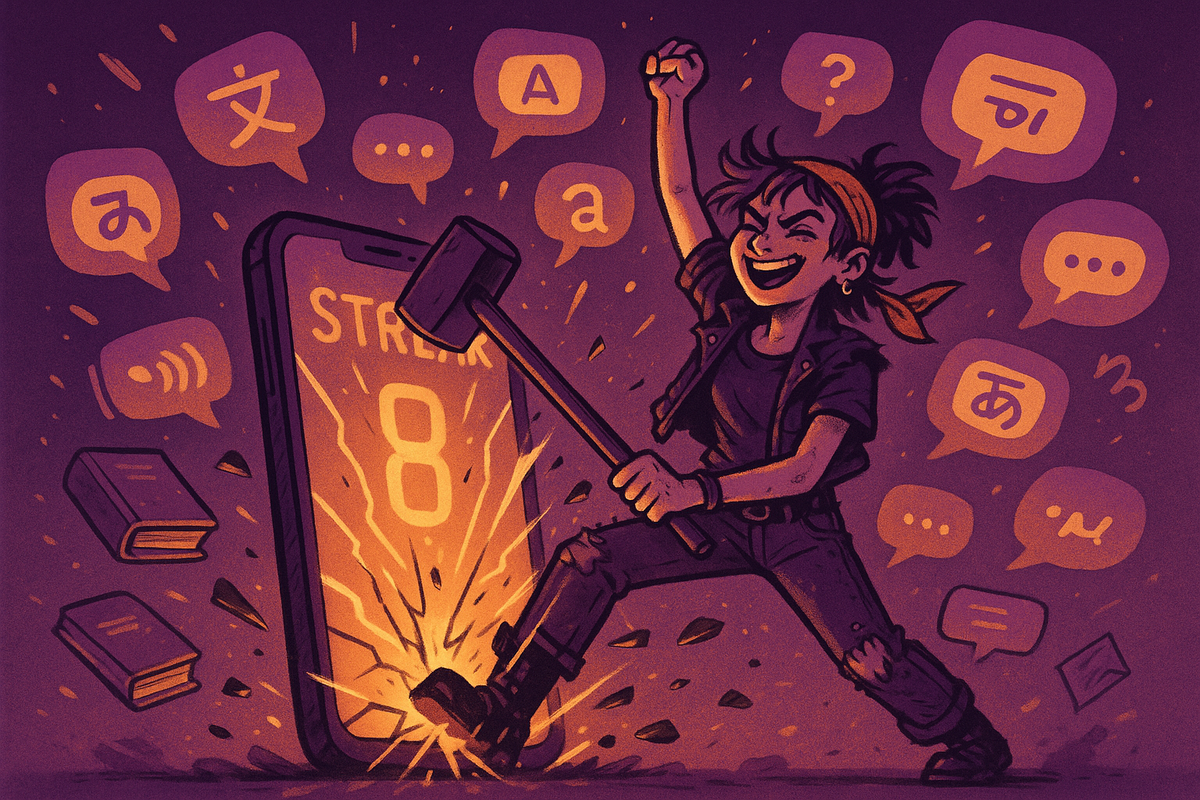
That's why streaks and gamification often fail too. They optimize for the wrong metric. True motivation comes from meaningful connection — with people, with culture, with a version of yourself you want to become.
Why the Death of Language Degrees Is Actually Good News
The collapse of university language programs creates space for something better to emerge. Here's what's already replacing them:
1. Community-Based Learning
Language exchange meetups, conversation clubs, and online communities are providing the social practice that universities always promised but rarely delivered. These are free, self-organized, and built around actual communication rather than academic assessment.
2. Immersion-First Programs
Organizations that prioritize immersion from day one — no English allowed, even for beginners — are producing conversational speakers in months rather than years. The discomfort is the point. Your brain doesn't need you to understand the subjunctive; it needs you to desperately want to tell someone that the bathroom is flooding.
3. Content-Based Acquisition
The explosion of native-language content online — YouTube, podcasts, TikTok, Netflix — means that anyone with an internet connection can access thousands of hours of authentic language input. This is more powerful than any curriculum because it's real, current, and infinitely varied.
4. AI-Augmented Practice
AI conversation partners aren't perfect, but they've solved one of the biggest barriers to language learning: the fear of judgment. According to a 2026 overview by Test Prep Insight, learners who practice with AI chatbots develop speaking confidence faster because there's no social penalty for mistakes. It's not a replacement for human interaction, but it's a powerful on-ramp.
The Inconvenient Truth Nobody Wants to Hear
The real reason language degrees are dying isn't that students are lazy, or that AI will replace human translators, or that "nobody values the humanities anymore." It's much simpler than that:
The product was bad.
If you spend three to four years and tens of thousands of dollars (or pounds) on a language degree and still can't comfortably chat with a cab driver in your target language, the program failed you. Period. No amount of literary analysis or phonological theory compensates for that fundamental failure.
Universities could have adapted. They could have embraced communicative methods, reduced class sizes to enable real conversation practice, integrated immersion experiences, and measured success by what students could do with the language rather than what they knew about it. Some progressive programs did exactly this and are thriving. Most didn't, and they're paying the price.
What This Means for You (The Rebel Learner)
If you're learning a language outside the traditional system, you're not a dropout or a dilettante. You're part of a massive shift in how humans acquire languages — one that's more aligned with how our brains actually work than anything a lecture hall ever offered.
Here's your rebel manifesto going forward:
- Prioritize speaking from day one. Not when you're "ready." You'll never feel ready. Speak badly, speak often, speak now.
- Consume massive input. Hours of listening and reading in your target language. Not textbook dialogues — real content that you actually enjoy.
- Find your people. Language partners, conversation groups, online communities. Learning in isolation is a recipe for quitting.
- Ignore the perfectionists. Anyone who corrects your accent before you've finished your sentence is not helping you. Native speaker worship is a trap.
- Measure progress by communication. Not by test scores, not by streak counts, not by grammar knowledge. Can you get your point across? Can you understand most of what you hear? That's fluency in the real world.
The Future Belongs to the Self-Directed
The language learning landscape in 2026 is being reshaped by people who refused to accept that a classroom was the only path to fluency. According to current language learning trends, the industry is moving rapidly toward adaptive, learner-driven approaches — exactly what rebels have been doing all along.
The death of the language degree isn't a tragedy. It's a correction. The old model served institutions more than it served learners, and the market finally caught up. What's emerging in its place — community-driven, immersion-focused, technology-augmented, and ruthlessly practical — is better for everyone who actually wants to speak another language rather than just study one.
Did you study a language at university? Did it actually make you fluent, or did you have to figure it out on your own afterward? Drop your story below — the more honest we are about what works and what doesn't, the faster we all get better.