Your Language Learning Streak Is Lying to You (And Here's the Proof)
Your language learning streak is not measuring your progress - it's measuring your app's engagement metrics. Here's the research that proves it, and what to do instead.
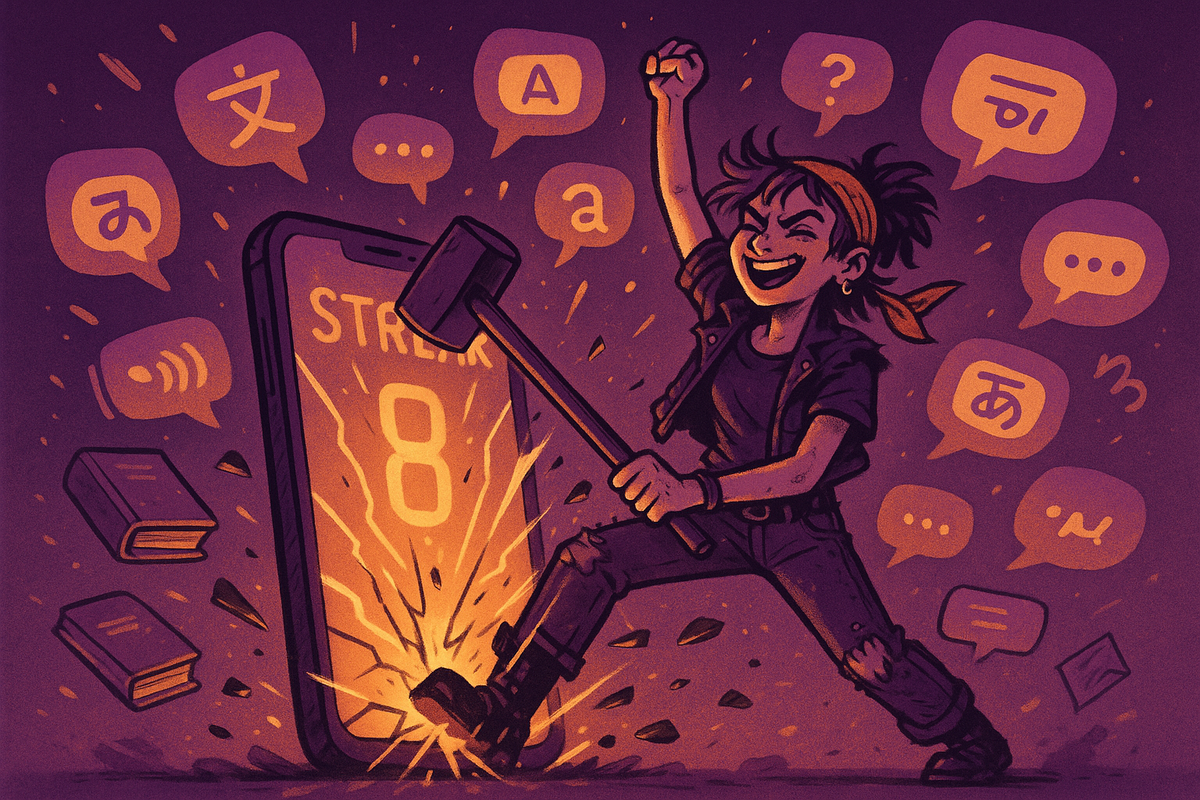
Everyone in the language learning world is obsessed with the daily language learning streak. Keep it alive. Protect it at all costs. Miss a single day and you've failed yourself, your target language, and possibly your ancestors. Language apps rake in billions of dollars selling you this idea. And it's one of the most quietly destructive forces in your language journey. Here's the truth nobody wants to say out loud: your streak is a performance metric for an app's engagement algorithm, not a measure of your actual progress.
The Language Learning Streak: A Billion-Dollar Illusion
The language learning streak was not invented to help you learn. It was invented to help apps retain users. There is a meaningful difference between those two goals, and pretending they're the same is how language learning platforms have turned millions of well-intentioned learners into anxious, app-dependent streak-protectors who speak approximately zero words of their target language after 18 months of "studying."
Think about the logic for a second. A streak counts days, not depth. It measures whether you opened an app, not whether you understood anything. It rewards you for clicking through five cartoon exercises at 11:58 PM to keep your counter alive. That's not language learning. That's digital superstition.
The gamification industry has known for years that streaks and external reward systems can undermine intrinsic motivation once the novelty wears off. Research published in peer-reviewed journals has repeatedly shown that when learners chase external rewards (like streaks, badges, and leaderboards), their genuine love for the learning process takes a hit. You started wanting to speak Spanish. Now you're afraid of the little sad owl.
What a Streak Actually Measures (Hint: Not Your Progress)
Let's be brutally honest about what maintaining a daily language learning streak actually measures:
- Your app-opening behavior — not your comprehension
- Your anxiety tolerance — because breaking a 200-day streak genuinely causes distress for many people
- Your willingness to be gamified — congratulations, you've become a product
- Your consistency on the easiest days — even sick days, travel days, family emergencies
Here's what a streak does not measure: whether you can hold a conversation, understand a film without subtitles, read a novel, or connect with a real human being in their language. You know, the actual goals.
A study in Frontiers in Psychology on gamification and language learning found that while gamified systems can boost short-term engagement, intrinsic motivation — the kind that actually drives long-term learning — depends on genuine interest, not external reward triggers. In other words: the streak might keep you opening the app. It won't keep you loving the language.
We've talked before about how language apps systematically fail to make you fluent. The streak is one of the main mechanisms by which they do this: by substituting the feeling of progress for actual progress.
The Psychology of Streaks: Why They Feel So Good (And Do So Little)
Streaks hijack your brain's reward circuitry. Every day you maintain one, you get a tiny dopamine hit. That hit is real. The learning it represents is often not.
Behavioral psychology calls this variable ratio reinforcement — the same mechanism that makes slot machines addictive. You're not being rewarded for learning Spanish. You're being rewarded for returning to the app. The app's business model requires daily active users. Your brain's reward system is simply the tool they use to get them.
What's particularly insidious is the loss aversion component. Research on gamification in education published by MDPI found that focusing too much on competition and external rewards can have negative effects on intrinsic motivation and academic performance. When your primary emotional experience around a language is fear of losing a streak, you're not learning from a place of curiosity and openness. You're learning from a place of anxiety. And anxious brains are not optimal language acquisition machines.
The moment you break a streak and feel crushing defeat — over a learning streak, something invented ten years ago by a Silicon Valley product team — you've let gamification colonize your relationship with an entire human language. That's worth getting angry about.
The "Consistency" Argument Is Being Used Against You
Streak defenders will say: "But consistency matters! Daily practice compounds!" And they're not entirely wrong. Consistency in language learning does matter. But here's what the consistency argument gets catastrophically wrong: consistency in output quality matters far more than consistency in daily check-ins.
Consider two learners:
- Learner A does 5 minutes of app exercises every single day for a year. Perfect streak. 1,825 minutes of total study time, mostly low-cognitive-load review.
- Learner B does 45 minutes of intensive, deep engagement five days a week — reading real content, having real conversations, wrestling with genuine confusion. Breaks "streaks" constantly. Total time: roughly 11,700 minutes.
Which learner is speaking the language in a year? The answer is not remotely close. And yet the streak-culture of language apps is optimized entirely to produce Learner A — because Learner A generates daily active user metrics. Learner B is bad for the business model.
This is related to something we've explored before: why chasing the wrong target in language learning keeps you permanently stuck. The streak is one of the most seductive wrong targets in existence, because it looks so much like real progress.
What Actually Works Instead of Daily Streak Culture
If you want to burn your streak counter to the ground and build something that actually gets you speaking a language, here's what the research and the results point toward:
1. Intensity Over Frequency
Deep, intensive sessions where you push beyond your comfort zone build neural pathways far more effectively than shallow daily touch-points. This is consistent with research on deliberate practice and cognitive engagement in learning contexts. You want sessions where your brain is actually straining, not gliding through review exercises you mastered three weeks ago.
2. Contextual Learning Over Isolated Drilling
Languages are not lists of isolated facts. They are living systems of meaning. When you encounter words in real, emotionally resonant contexts — a story you care about, a conversation that matters — you remember them because meaning is encoded alongside the language, not just the form. Streaks push you toward drilling. Real acquisition pushes you toward experiencing the language in use. The difference in outcome is enormous.
3. Process Goals Over Performance Metrics
Instead of "maintain a streak," try "finish this podcast series in Italian" or "get through one chapter of this novel in Portuguese this week" or "have one real conversation where I say something I've never said before in French." These are goals attached to actual linguistic experiences, not to an app's engagement engine. They're harder to gamify. That's exactly why they work.
4. Embrace Gaps Without Shame
Real language learners — the ones who actually become fluent — miss days. They have weeks when life intervenes. They pick it back up. The language doesn't disappear while you're dealing with your life. What kills language learning is not missing a day. It's the guilt spiral that follows missing a day, which the streak system is specifically designed to create. Break the streak. Learn anyway. The language doesn't care about your app counter.
5. Find Your Intrinsic Hook
The most powerful language learning motivation on earth is wanting to access something you can only access in that language — a community, a piece of culture, a relationship, a body of literature. Streaks cannot manufacture this. Only you can find it. But when you do, you won't need an app to remind you to study. You'll be hungry for it in a way that no gamification system can touch. We've written about how to redirect that energy into what actually moves the needle.
The Dirty Secret Behind Streak Culture
There's a reason language learning apps spend enormous resources on streak mechanics, push notifications, "streak freeze" purchases, and guilt-inducing mascots. Keeping you returning daily is worth far more to them than making you fluent. A fluent user has completed their journey and might stop subscribing. A user perpetually afraid of breaking their streak is a subscriber forever.
A 2024 study on gamification and language learning outcomes found that while gamification can influence certain metrics, the mechanisms at play are primarily about short-term engagement — not long-term acquisition. The business incentive and the learner's interest are structurally misaligned. The streak is the sharpest edge of that misalignment.
This isn't a conspiracy. It's just capitalism doing what capitalism does. But you don't have to play along. Recognizing the game is the first step to opting out of it — and that's what rebels do. It connects to the broader pattern we've explored: how the language learning industry profits from keeping you perpetually "learning" rather than actually learned.
How to Kill Your Streak (And Finally Start Learning)
Here's a practical exit strategy from streak culture:
- Delete the app streak counter from your mental priority list. It is not a proxy for your progress. Treat it as what it is: a retention tool.
- Replace daily check-ins with weekly reviews. At the end of each week, ask: did I engage meaningfully with this language? Not "did I open the app every day?"
- Set session depth minimums, not frequency requirements. "When I study, I study for at least 30 minutes of real engagement" beats "I study for 5 minutes every day no matter what."
- Track actual skills, not app time. Can you understand more than you could last month? Can you express something new? That's real progress data.
- Miss a day on purpose. Seriously. Break the streak deliberately. Notice that the language is still there. Notice that you're fine. Notice that the guilt was manufactured.
The Rebel Bottom Line
The language learning streak is one of the cleverest traps ever set for learners who genuinely want to improve. It wears the costume of discipline while delivering anxiety, shallow engagement, and an app company's quarterly user retention numbers. Real language acquisition happens in the deep, messy, inconsistent, passionate engagement with a language — not in the daily ritual of opening an app to keep a counter alive.
You don't owe any app your streak. You owe your target language your full attention when you can give it, your real curiosity when it lights up, and your honest engagement with the discomfort of not yet knowing. That's it. That's the whole practice.
Burn the streak. Learn the language.
Now it's your turn: Have you ever done something embarrassingly desperate to protect a language learning streak — opened an app at midnight, tapped through exercises on autopilot just to keep the counter going? What happened when you finally let the streak die? Tell us in the comments. We want the confessions. We won't judge. (We might laugh with you.)