Why Flashcards Do Not Help You Speak a Language in 2026: The Vocabulary Obsession Keeping You Quiet
Why flashcards do not help you speak a language is simpler than people want to admit: isolated-word review can build memory, but it does a lousy job building real-time speech.
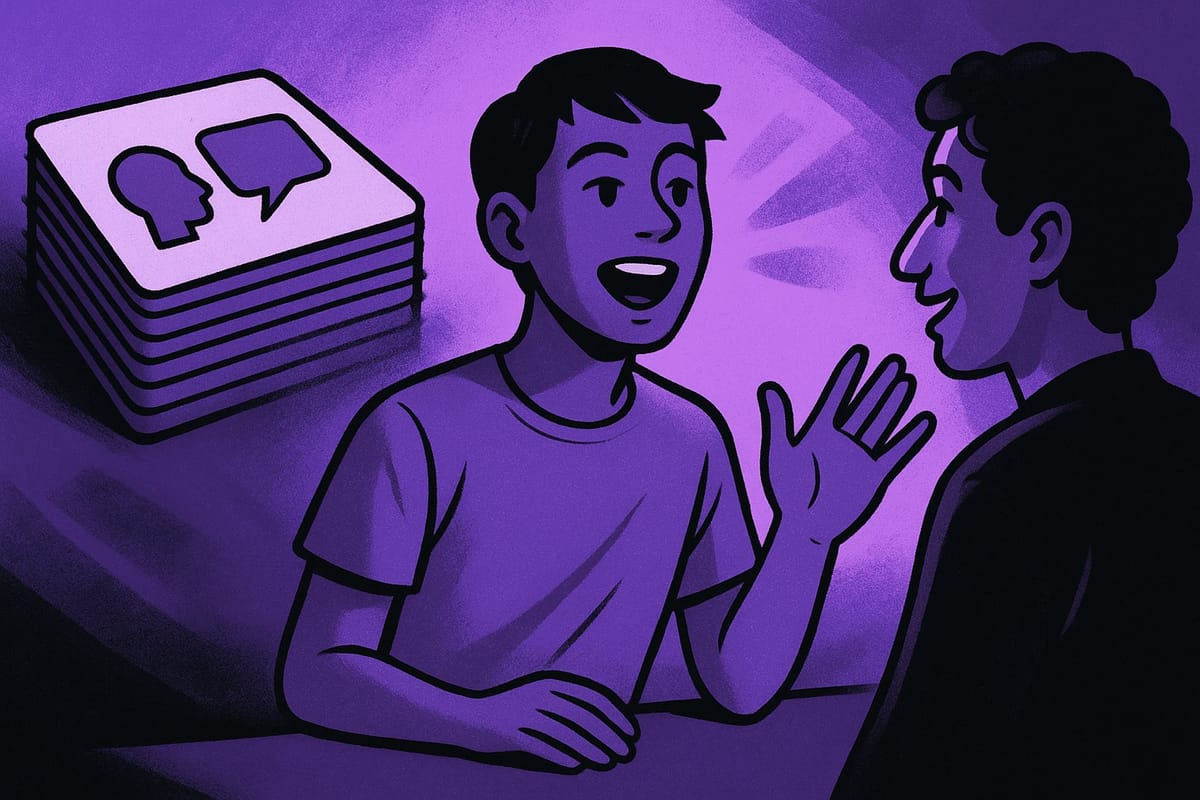
Why flashcards do not help you speak a language is not some anti-study hot take. It is a painfully practical observation. You can know hundreds of isolated words, keep a heroic streak alive, and still sound like your mouth has never met the language before. That is because speaking is not a trivia contest. It is fast, messy, social performance under time pressure. Flashcards can help you recognize and recall items, sure, but if your whole system revolves around single-word review, you are training for the wrong sport.
If you have already read how to stop translating in your head, called out the fantasy in passive listening for language learning, or started leaning into discomfort with how to stop being afraid to speak a language, this is the next thing to fix. A lot of learners are not underprepared because they lack vocabulary. They are underprepared because they have studied vocabulary in a form that barely resembles speech.
Why flashcards do not help you speak a language the way you think they do
Flashcards feel productive because they give you clean wins. You see a prompt, you remember an answer, you get a tiny dopamine pellet, and your brain goes, “hell yeah, we are learning.” The problem is that conversation does not look like that. Nobody walks up to you in Madrid, Seoul, or Berlin and asks you to translate “umbrella” in perfect isolation. Real speaking asks for something uglier and more demanding:
- finding words quickly enough to keep the interaction alive
- combining those words into patterns that sound natural
- adjusting to tone, context, and what the other person just said
- doing all of that before panic smashes your working memory
That is why frameworks like the ACTFL Proficiency Guidelines treat speaking as real-time functional performance, not just stored knowledge. Knowing a word and being able to deploy it smoothly inside a living sentence are two different jobs. Flashcards usually train the first one. Learners assume that means the second one is coming later. A lot of the time, it never really does.
This is where people get defensive. “But flashcards helped me build vocabulary.” Fine. They can. That is not the same as helping you speak. Owning a pile of dumbbells does not mean you can play decent basketball. Related? Sure. Same skill? Not even close.
Why flashcards do not help you speak a language in actual conversations
When you try to speak, your brain is not reaching for museum-labeled single words. It is reaching for ready-made combinations: I was going to..., the thing is..., I am not sure how to say this, it depends on..., have you ever.... Speech runs on phrase-level units, not just dictionary entries.
Research on formulaic language keeps hammering this point. Kristopher Oberg’s paper on formulaic sequences and oral fluency argues that chunks support smoother production because speakers retrieve larger units instead of building every sentence from scratch. The ERIC paper Formulaic Language in Acquisition and Production makes the same basic case: formulaic units are central to both acquisition and fluent use, not some optional bonus content for advanced learners. Cambridge’s Learning Language in Chunks guide says it even more plainly for teachers: spoken language is packed with prefabricated chunks, collocations, and recurring bundles.
That matters because flashcards often slice language at exactly the wrong seam. They teach:
- decision
- improve
- avoid
- confident
But conversation needs:
- I have not decided yet
- it got better once I started...
- I try to avoid that because...
- I do not feel confident enough yet
The second list is uglier, longer, and harder to turn into a neat little deck. Too bad. That is the version your mouth actually needs.
The real problem with flashcards is not memory, it is transfer
A lot of language learners think the bottleneck is memory. It often is not. The real bottleneck is transfer. Can you move something from recognition into spontaneous use? Can you grab it under pressure, fit it into a sentence, and keep talking without freezing?
This is exactly why so many people stay stuck in the weird middle ground where they “know a lot” and still cannot speak. They have built a private warehouse of language they rarely use in public. Their vocabulary exists, but it does not travel well.
And to be fair, the problem is not only flashcards. The same fake-progress disease shows up in other comfortable routines. That is why passive listening leaves people feeling diligent but mute, and why speaking confidence exercises matter so much: they force retrieval under conditions that look more like real speech. Flashcards are just the cleanest example of the bigger trap. They reward easy recall in a sterile format, then quietly fail to cash out in conversation.
That disconnect gets worse when learners pair flashcards with constant mental translation. If every word you review still has to travel through English before reaching your mouth, you are not building fluent access. You are building a bureaucratic delay. That is why fixing mental translation matters more than adding another 300 cards to your deck.
What flashcards are actually good for
Let’s not do fake nuance theater. Flashcards are not useless. They are just wildly overpromoted.
Flashcards can help with:
- getting familiar with high-frequency vocabulary
- keeping rare but important words from disappearing
- learning forms that genuinely benefit from brute-force recall
- supporting reading and listening when the target words also appear in meaningful input
That is a perfectly fine supporting role. The problem starts when flashcards become the main act. If your language routine is mostly reviewing cards, protecting streaks, and congratulating yourself for not forgetting isolated items, you are not training speaking. You are doing admin.
Even reputable language platforms have started admitting this. Lingoda’s 2026 language-learning lessons recap points out that endless flashcards, passive input, and gamified streak-chasing can create the appearance of progress while productive skills lag behind. That is the part most learners do not want to hear. A streak is not a sentence. A review count is not a conversation.
Why flashcards do not help you speak a language as much as chunks, scripts, and scenes do
If you want faster speech, stop worshipping isolated vocabulary and start collecting usable language. That means chunks, scripts, and repeatable scenes.
Chunks
Chunks are small prefabricated units that buy you speed. Instead of assembling grammar Lego in real time, you pull a whole piece off the shelf:
- the reason I ask is...
- I used to think that, but...
- what I mean is...
- it took me a while to...
That is how speech gets smoother. Not because you suddenly became brilliant, but because you stopped rebuilding common patterns from scratch every time.
Scripts
Scripts are slightly bigger. They cover recurring real-life needs: introducing yourself, explaining your work, ordering food, making a complaint, telling a short story, giving an opinion. Learners avoid scripts because they think they are “not real speaking.” That is backwards. Scripts are exactly how you earn the right to freer speaking later. They give you stable ground.
Scenes
Scenes make the language move. Instead of “learn 20 restaurant words,” you practice a restaurant interaction. Instead of “memorize travel vocabulary,” you rehearse missing a train, asking for help, and changing plans. Scenes force vocabulary, grammar, and rhythm to work together. That is the transfer flashcards usually fail to create.
This is also why deliberate discomfort works. In the deliberate-discomfort method, the point is not suffering for sport. The point is exposing yourself to speaking conditions where language has to come out in connected form. That is where fluency grows. Not in your 487th review of a word you still only use on a screen.
A better replacement for flashcard obsession if you actually want to speak
If you are serious about speaking, here is a better workflow than endless card review.
1. Mine phrases, not orphan words
When you encounter something useful, save the whole usable unit. Not improve. Save I am trying to improve my listening. Not awkward. Save it was a little awkward at first. Your future speaking self does not need a dictionary entry. It needs a launchable sentence frame.
2. Rehearse those phrases out loud
Say them. Change them. Bend them. Put them in first person, past tense, negative form, question form. If the phrase stays silent, it stays weak.
3. Build tiny monologues around common topics
Pick topics you actually use in life:
- what you do for work
- how your week has been
- why you are learning the language
- what you are struggling with
- what you did last weekend
Build 30- to 60-second responses using your chunks. This is not glamorous. It works anyway.
4. Do retrieval in context
If you still want some spaced repetition, fine. Just stop using it like a shrine. Review phrase cards, mini-dialogues, or scene prompts. Better yet, try to answer aloud before revealing anything. Now you are at least training recall in a format that resembles speaking.
5. Record, notice, repair
Say a short answer out loud. Record it. Listen once. Fix one ugly part. Do it again. That loop will help your speaking more than another hour of thumb-flicking through cards while pretending you are on the path to fluency.
The blunt takeaway on why flashcards do not help you speak a language
Why flashcards do not help you speak a language comes down to one simple truth: speaking depends on rapid access to connected language, not just stored definitions. Flashcards can support memory. They cannot, by themselves, build the timing, phrasing, and flexibility that conversation demands.
So keep a few cards if they serve a purpose. But stop confusing vocabulary maintenance with speech training. Stop mistaking neat dashboards for communicative ability. Stop acting like more isolated words will somehow rescue a silent mouth.
If you want to speak, train speech. Learn chunks. Rehearse scripts. Build scenes. Use the language before you feel ready. That is messier than flashcards, but it is also why it works.
Be honest: how much of your current study routine would still survive if you judged it by one standard only — does this make it easier for me to open my mouth and say something real?